How global events permanently reshape cities
After years of anticipation, FIFA World Cup 2026 is only 115 days away, and Atlanta is preparing to take its place on one of the world’s biggest stages. The city is ready not just to host matches but also to showcase its growth, ambition, and international connections.
Atlanta has been here before. In 1996, the city welcomed the world for the Summer Olympics, an event that transformed its identity, infrastructure, and international profile. Thirty years later, the World Cup presents an even larger platform. Bigger than the Super Bowl in scale and reach, this global tournament offers the chance to attract new international companies, expand trade relationships, and highlight Atlanta’s cultural vibrancy on the world stage.
That global spotlight is mirrored in Atlanta’s thriving soccer scene. Momentum has been building steadily for years. Atlanta United’s 2018 MLS Cup victory, achieved in just their second season, was a defining moment for professional soccer in the city. This year, the U.S. Soccer Federation opens its new headquarters and national training center in Fayette County, just south of Atlanta and near Hartsfield-Jackson International Airport. The facility will serve as a hub for talent and development, helping the sport grow at every level. And the momentum doesn’t stop there. Atlanta will welcome the 17th National Women’s Soccer League team in 2028, further cementing the city’s growing influence in U.S. soccer.


Fans will have the chance to witness top teams in action. From June 15 to July 15, 2026, Mercedes-Benz Stadium, known as the Atlanta Stadium for the World Cup, will host eight exciting matches — including a semifinal — bringing teams and fans from across the globe. The schedule includes:
Global connections give this World Cup added meaning. Several countries share historic sports milestones with Atlanta. Cabo Verde and Uzbekistan both made their Olympic debuts at the 1996 Atlanta Games, forging ties that still resonate today. South Africa’s bond traces back even further. In June 1990, Nelson Mandela addressed more than 50,000 people at Georgia Tech’s Bobby Dodd Stadium — a moment symbolizing international solidarity and the fight for democracy. Returning to Atlanta for the World Cup will be a full-circle moment for these nations, linking past milestones to the excitement of today’s global stage.

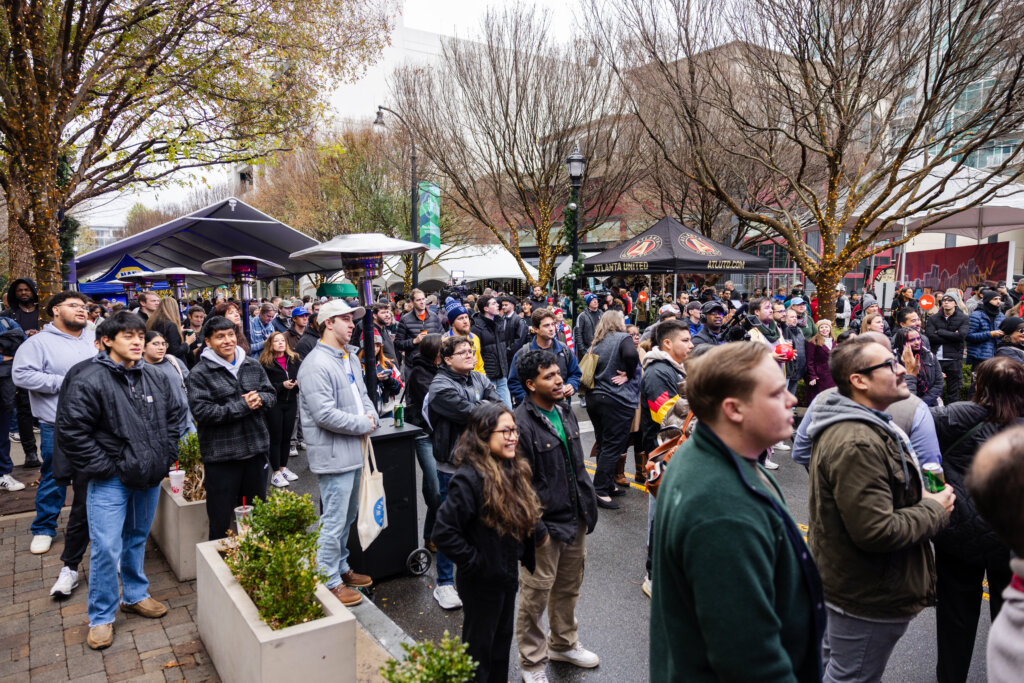
Economic and strategic partnerships highlight another side of Atlanta’s global connections. Spain has long been a key partner, with nearly 20,000 Spanish visitors arriving each year. In 2024 alone, trade between Georgia and Spain reached $1.7 billion. Daily nonstop Delta flights from Madrid and Barcelona make the Atlanta region highly accessible, while companies like Flatiron Dragados continue to invest here, bringing new jobs and growth.
Morocco is another important partner. Leading Georgia-based companies, including AGCO, The Coca-Cola Company, Georgia-Pacific, and Newell Rubbermaid, are are expanding their presence in the country. In October 2025, Delta launched weekly nonstop flights from Marrakech, creating the first-ever direct connection between Morocco and the Southeast U.S.
Forward-looking connections extend to Saudi Arabia, highlighting shared priorities in AI, fintech, and digital transformation, and a Riyadh nonstop flight announced for October 2026 promises to strengthen ties further. At the same time, the city of Atlanta continues to celebrate its Haitian community. Last year, the Federation of Haitian Chambers of Commerce launched in Atlanta, connecting more than 800 local business owners and emphasizing the city as a hub for Haitian culture and enterprise.
FIFA World Cup 2026 is a once-in-a-generation event, and Atlanta will be at the center of it all. For a month, teams and fans from across the globe will converge for world-class matches, rich cultural connections, and historic moments in the making. But the story doesn’t end when the final whistle blows. From Olympic legacies to new international partnerships and a thriving local soccer scene, the excitement, pride, and global connections sparked by the World Cup will resonate for years to come, leaving a lasting mark on the city and the region.

