The 2026 legislative session and bill signing period closed with some wins worth celebrating: a stronger business court, incentives to jumpstart an emerging fuel industry, and smart investments in Georgia's future.
Though every Georgia Legislative Session has high points and low ones, this year’s was marked by a series of deliberate, well-crafted decisions that will compound in value for years.
The MAC Public Policy team worked to support a number of successful initiatives passed by the legislature and signed into law by Governor Brian Kemp, including legislation curbing frivolous website litigation, protecting major economic development tax incentives, and revising regulations on housing and occupational licensing.
Here are three pieces of legislation recently signed into law that stand out for MAC and the metro Atlanta business community:
Georgia Looks to the Future on Sustainable Aviation Fuel
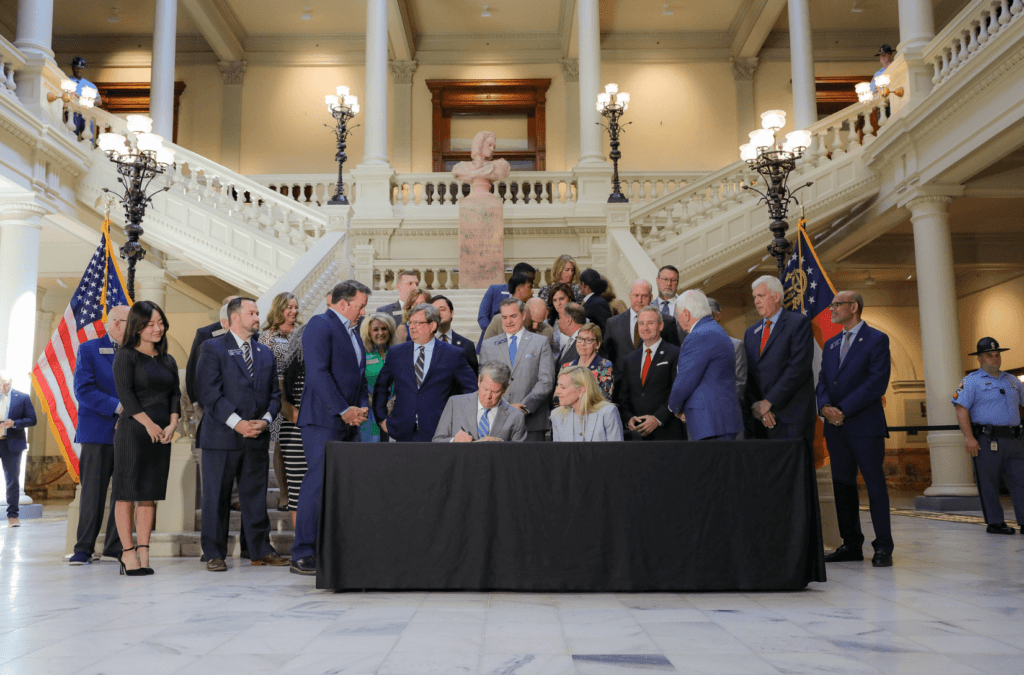
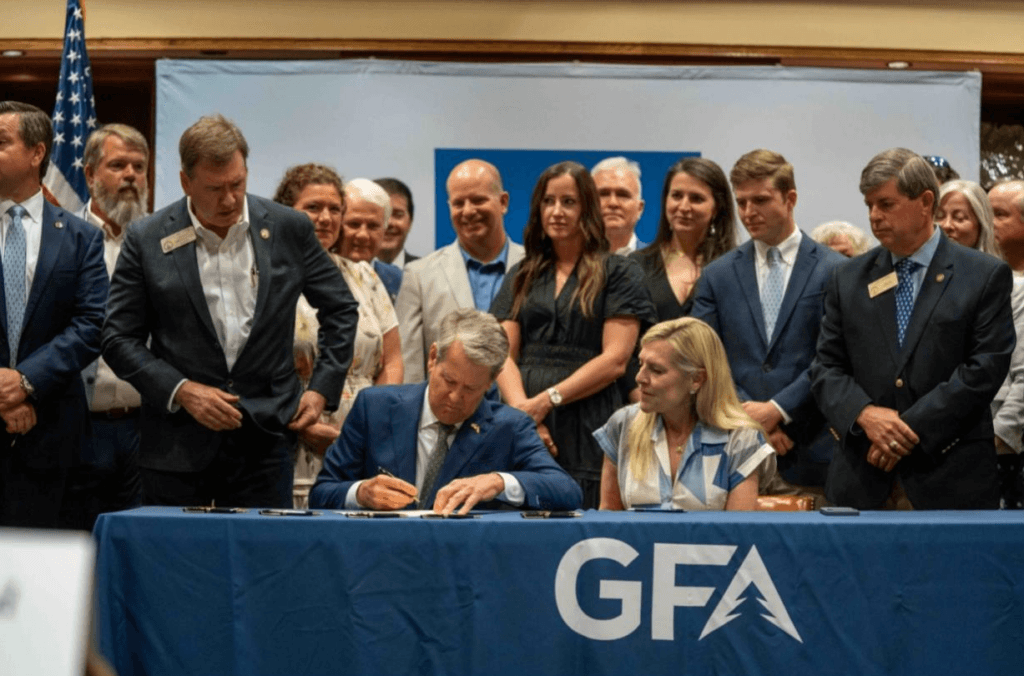
Gov. Kemp signed House Bill 134 into law on May 6. This legislation extends Georgia’s existing Jobs Tax Credit and Investment Tax Credit to forestry manufacturers, including manufacturers of biofuels using Georgia-based feedstocks. The credit is capped at $250 million over five years, meaning this bill could result in more than $1 billion in added investment in Georgia. Critically, the bill allows those credits to be transferred, giving Georgia a real competitive edge.
But most importantly, it widens the door of opportunity for an industry that has long been a cornerstone of rural Georgia’s economy while positioning our state to lead in an emerging industry.
In addition to supporting Georgia’s strength as a forestry state, the bill encourages growth in Sustainable Aviation Fuel (SAF) production, which leverages forest products and biomass. The timing is ideal, with EU regulations requiring airlines to increase SAF in their fuel supply for flights departing European airports. Local companies buying or selling products in Europe and global companies with EU operations both have a direct commercial interest in available and affordable SAF. And Atlanta’s position as home to the world’s busiest and most efficient airport puts Georgia at the center of that demand.
What emerged is the foundation for a growing industry that further knits together the metro Atlanta region and rural areas of the state. The General Assembly also appropriated funding for a Georgia Research Alliance (GRA) Eminent Scholar at Georgia Southern University to focus on the forestry sector and help identify emerging opportunities.
Alongside the legislation, a new Georgia SAF Coalition is preparing to launch. The coalition represents something vital to economic development: metro Atlanta and rural Georgia working toward the same goal, alongside global market demand pulling in the same direction. More information will be released about the Coalition in early summer 2026.
A Stronger Foundation for Businesses That Call Georgia Home
Georgia has been the #1 State for Business for twelve years. Maintaining that distinction means attending to the less-visible infrastructure of business confidence, including how companies resolve disputes when things go wrong.
House Bill 1185, signed into law on May 11, revises Georgia’s Corporate Code in consequential ways which make Georgia more competitive. Since 2020, Georgia has had a Statewide Business Court, a specialized court presided over by judges who understand complex commercial matters. The court, however, has been underutilized, hampered by procedural requirements that made it difficult for businesses to access. HB 1185 makes it significantly easier for companies to bring internal disputes — shareholder proceedings, officer disputes, and record inspections — before judges who have spent their careers understanding how businesses actually work.
The expected result: the Business Court’s caseload could double. This means disputes that once dragged through general courts for years will move faster, with more expertise, at lower cost — freeing businesses to make decisions, hire people, invest, and innovate.
The bill also refines protections against meritless litigation. If a court determines that a claim was brought without legitimate basis, the filing party may be required to cover the company’s legal costs. It’s a straightforward safeguard that discourages bad-faith suits without closing the door to legitimate ones.
Throughout his administration, Governor Kemp has prioritized economic growth across the state, and this legislation helps strengthen the foundation for business success.
As MAC President & CEO Katie Kirkpatrick has noted, companies deciding where to grow don’t just ask about taxes and talent. They ask whether Georgia’s judicial system is a place where they’ll be treated fairly. HB 1185 helps answer that question with confidence.
Investing in What Georgia Will Need Next
The session’s budget work reflected a clear-eyed view of what Georgia’s competitiveness will require in the years ahead. A few highlights:
The amended fiscal year 2026 budget, signed by Governor Kemp on March 3, includes $5 million for infrastructure and security costs tied to Super Bowl LXIII in 2028. Atlanta has built a well-earned reputation as a world-class events city. This necessary “down payment” ensures the host committee and key partners have the resources necessary to host one of the most logistically demanding events in sports while keeping fans and Georgians safe.
That budget also included $325 million for a need-based scholarship program for students who might otherwise lack a viable path to a degree. Georgia’s talent pipeline is one of our most fundamental competitive assets, and this investment ensures that pipeline isn’t narrowed by financial circumstance.
The fiscal year 2027 budget added funding for the Georgia Research Alliance for two Eminent Scholar endowments — an investment in the research infrastructure that drives discovery, attracts talent, and generates the company formation that keeps Georgia’s innovation economy growing. As Georgia’s long-standing organization for bridging academia, industry, and government, the GRA is uniquely positioned to serve as Georgia’s strategic convener and catalyst for transformative research initiatives.
And for Georgia’s communities, the session included a $45 million appropriation for the State Housing Trust Fund, along with a new requirement for coordinated data-sharing among organizations serving homeless individuals in Fulton County — a step toward the kind of systems-level approach that we believe can actually move the needle on one of the region’s most persistent challenges.
What This Session Signals
Taken together, these wins reflect something important: Georgia’s willingness to make the unglamorous, long-horizon decisions that keep it competitive. A tax credit for a fuel that many people haven’t heard of yet. A procedural fix to a court most people will never set foot in. Budget lines for research, scholarships, and housing that won’t generate many headlines but will make an impact.
But these are precisely the decisions that compound over time. They are the foundation on which bigger ambitions are built.
The Metro Atlanta Chamber is grateful for the leadership of Governor Brian Kemp, Lt. Governor Burt Jones, and House Speaker Jon Burns, and the members of the General Assembly for their work this session.
And we are proud of our MAC team members Leanna Brown, Sky Park, Nick Fernandez, Musaddaq Hassan, Maggie Wigton, and Tim Cairl – led by Dave Williams, Chief Policy Officer – who worked steadily and tirelessly to advocate for this important progress.
For the full list of legislation MAC tracked this session, visit the 2026 Sine Die Report.

